
Person
Mawby, Maurice Alan Edgar (1904 - 1977)
Kt FAA FTS
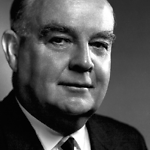
Maurice Alan Edgar Mawby
Details

- Born
- 31 August 1904
Broken Hill, New South Wales, Australia - Died
- 4 August 1977
East Melbourne, Victoria, Australia - Occupation
- Mineralogist and Business executive
Summary
Sir Maurice Mawby was an expert in mining and metals treatment. He held many appointments including technical secretary (1941-1944) of the Commonwealth Copper and Bauxite Committee (Australia); manager of New Broken Hill (1944) where he was chief metallurgist; director of research and development with Broken Hill Associated Smelters Pty Ltd (from 1945) and director of exploration and research at Zinc Corporation.
Details
Chronology
- 1952 - 1954
- Career position - President, Australasian Institute of Mining and Metallurgy
- 1955
- Award - Doctor of Science (DSc), honoris causa, New South Wales University of Technology
- 1955
- Award - The Institute Medal, Australasian Institute of Mining and Metallurgy
- 1958
- Career position - President, Australasian Institute of Mining and Metallurgy
- 1959 -
- Career position - Inaugural President, Australian Mineral Industries Research Association Limited (AMIRA)
- 1 Jan 1959
- Award - Commander of the Order of the British Empire (CBE) - Industry
- 1 Jan 1963
- Award - Knight Bachelor - Services to mining and industry
- 1965
- Award - Kernot Memorial Medal, for distinguished engineering achievement in Australia. Faculty of Engineering, University of Melbourne
- 1969 - 1977
- Award - Fellow, Australian Academy of Science (FAA)
- 1975 - 1977
- Award - Foundation Fellow, Australian Academy of Technological Sciences (FTS)
Related entries
Archival resources
The University of Melbourne Archives
- Maurice Alan Mawby - Records, 1902 - 1977, 81/127; The University of Melbourne Archives. Details
Published resources
Books
- Porter, Robert, Mining men: individuals who shaped Australia's post-war development (Kew, Vic.: RPorter Writing Services, 2024), 233 pp. Details
Book Sections
- Strahan, Frank, 'Mawby, Sir Maurice Alan Edgar (1904-1977), industrialist' in Australian dictionary of biography, volume 15: 1940 - 1980 Kem-Pie, John Ritchie, ed. (Melbourne: Melbourne University Press, 2000), pp. 333-335. https://adb.anu.edu.au/biography/mawby-sir-maurice-alan-edgar-11090. Details
Edited Books
- Legge, J. S. ed., Who's who in Australia 1968 (Melbourne, Victoria: The Herald and Weekly Times Ltd, 1968), 955 pp. "Mawby, Sir Maurice Alan Edgar", p.601. Details
- Woodcock, J. T. ed., Mining and metallurgical practices in Australasia : the Sir Maurice Mawby memorial volume (Parkville, Vic: Australasian Institute of Mining and Metallurgy, c1980), 947 pp. Details
Journal Articles
- 'Obituary; Sir Maurice Mawby, CBE', Proceedings of the Australasian Institute of Mining and Metallurgy, 263 (1977), 1-2. Details
- Wark, I. W.; and Ellis, E. G., 'Maurice Alan Edgar Mawby 1904-197', Historical Records of Australian Science, 5 (1) (1980), 104-128. https://doi.org/10.1071/HR9800510104. Details
Resources
- Wikidata, http://www.wikidata.org/entity/Q21083482. Details
- VIAF - Virtual International Authority File, OCLC, https://viaf.org/viaf/67788287. Details
- 'Sir Maurice Mawby', Fellows of the Academy, 2024, https://www.atse.org.au/who-we-are/our-fellows/all-fellows/maurice-mawby/. Details
- 'Mawby, Maurice (1904-)', Trove, National Library of Australia, 2009, https://nla.gov.au/nla.party-618484. Details
See also
- 'Dr Keith Thomas Henry Farrer OBE MA DSc FTSE - Biographical Note', Australian Academy of Technological Sciences and Engineering, http://www.atse.org.au/index.php?sectionid=648. Details
- Birch, W. D.; and Henry, D. A., 'The geology collections of Museum Victoria, Melbourne', Australian Journal of Mineralogy, 6 (2) (2000), 83-91. Details
- Branagan, David, 'Australian Geochemical Mineral Exploration: it all began at Moonta through V. P. Sokoloff', Journal of Australasian Mining History, 5 (2007), 20-38. Details
Digital resources
Rosanne Walker; Ken McInnes
Created: 29 June 1995, Last modified: 5 March 2026